The Ultimate Guide to Chinese Province Stereotypes Online

The Ultimate Guide to Chinese Province Stereotypes Online

Mar 13, 2026 Updated Mar 14, 2026 4 sections 23 min read

Discover how Chinese people joke about each province online. This guide explains viral stereotypes, regional memes, and internet culture across China.

If you’ve ever browsed Chinese forums, TikTok comments, or meme pages, you’ve probably noticed something interesting: Chinese people love making jokes about each other’s provinces. Every region in China has its own reputation online — some are seen as rich, some as spicy-food obsessed, some as business geniuses, and some… well, let’s just say the internet can be brutal.

This article is your ultimate crash course to China’s province stereotypes, the kind you’ll see on Chinese social media, Reddit threads, Bilibili videos, and meme maps that go viral every year. Think of it like the Chinese version of those “How Americans see Europe” or “How Europeans see the US” maps — funny, exaggerated, sometimes accurate, sometimes completely ridiculous, but always entertaining.

We’re not talking about official facts here. These are internet stereotypes shaped by history, food culture, economics, migration, and years of online jokes. For example, some provinces are famous for doing business, some for being great at exams, some for their accents, and others for their spicy hotpot tolerance. If you shop on AliExpress, watch Chinese TikTok, or follow China tech and pop culture, you’ve probably seen these jokes without fully understanding them.

In this guide, we’ll walk through the most popular stereotypes province by province, explain where they come from, and why Chinese netizens keep using them. By the end, you’ll understand the hidden humor behind one of the most viral meme formats in Chinese internet culture — the legendary “map of China in everyone’s eyes”.

📖 Article Contents

Henan: A Province with a Built-in “Center of the World” Filter


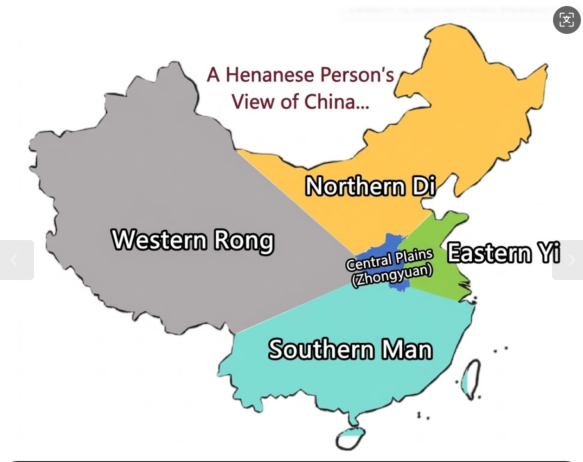
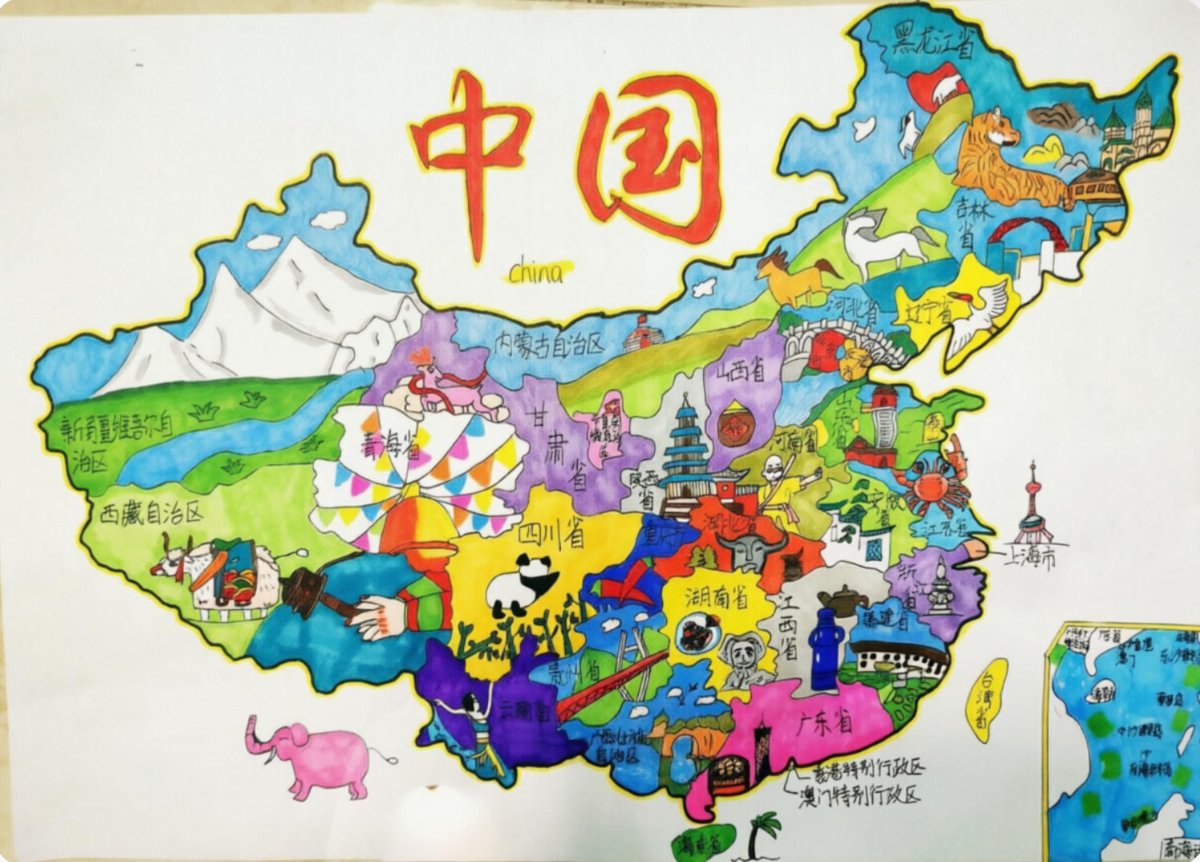
In the worldview of many people from Henan, the map of China looks something like this:
the blue patch in the middle is the Central Plains①, meaning their hometown;
to the north are the “Northern Di,” to the east the “Eastern Yi,” to the south the “Southern Man,” and to the west the “Western Rong②.”
This isn’t arrogance — it’s the deeply ingrained Central Plains complex. After all, the word “China” originally referred to the area around Luoyang③, so the confidence comes straight from the ancestors.

Outsiders love to joke about Henan, and the most famous meme is the so-called “manhole cover stealing”⑧ joke.
People from Henan have long learned to laugh at themselves:
“Each of us owns a manhole cover — we use it to cover the antiques underground.
After all, if you dig anywhere, you might hit bronze ware or terracotta figures, and those are worth more than the cover.”
The saying “For underground relics, look to Henan” isn’t an exaggeration.
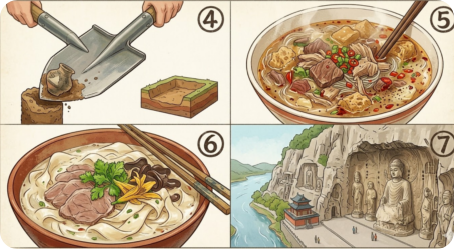
Even the famous Luoyang shovel④ became a standard tool in archaeology.

When it comes to food, Henan people have carved the idea of hearty and practical into their stomachs.
In the morning, a bowl of Hu La Tang⑤, paired with fried dough bread, spicy enough to wake the soul.
At noon, a bowl of Hui Mian⑥, wide noodles soaked in rich broth, with meat flavor wrapped around the aroma of wheat — even the soup gets finished.
Visitors often ask, “Do you really eat Hu La Tang every day?”
Henan people just smile:
“How else could we survive the cold winds of the Central Plains?”

They also love the word “Zhong” (中) — a universal answer.
“Eat Hui Mian at noon?” — “Zhong!”
“Go see the Longmen Grottoes⑦?” — “Zhong!”
“Stop making fun of us?” — “… Zhong or not?”
Inside this single word lies the straightforwardness and easygoing nature of Henan people,
and also the calm confidence of living in the land at the center of the world.

Today’s Henan is no longer the stereotypical agricultural province.
Zhengzhou’s high-speed rail network connects the entire country,
Luoyang’s peonies amaze visitors from around the world,
and Kaifeng’s night markets are full of lively street-food culture.
While joking about being “rustic,” Henan people are also reinventing Central Plains culture —
TV galas from Henan have gone viral online, using dance, music, and visual effects to bring the Tang and Song dynasties back to the stage,
showing the whole country that the roots of the Central Plains have never been broken.

For people from Henan, the joke about
“Eastern Yi, Southern Man, Western Rong, Northern Di”
is nothing more than affection for their homeland.
They know that the center of the world has never been just a geographical concept —
it is a cultural identity carved into the bones.
No matter how far they travel, a simple word — “Zhong” — is the signal that they are home.


Notes & Background

Central Plains (Zhongyuan)
In a narrow sense, the Yellow River middle-lower basin centered on Luoyang (mostly in modern Henan).
It is one of the core birthplaces of Chinese civilization and was the political, economic, and cultural center for much of history.

Eastern Yi, Southern Man, Western Rong, Northern Di
Ancient terms used by early Central Plains states to refer to surrounding tribes in the four directions.
They are historical labels, not modern ethnic concepts, and are used here humorously.

The earliest meaning of “China”
The Western Zhou bronze inscription on the vessel He Zun contains the phrase “dwelling in Zhongguo,”
the earliest known use of the word, referring to the region around Luoyang.

Luoyang Shovel
A tool invented by tomb raiders in Luoyang to probe soil layers and locate underground structures.
It was later adopted by archaeologists and became a symbolic reference to Henan’s rich underground relics.

Hu La Tang
A classic Henan breakfast soup made with pepper, chili, meat, gluten, and vermicelli.
Spicy, thick, and warming — considered the soul of a Central Plains morning.

Hui Mian
A signature Henan noodle dish cooked in rich bone broth, often with lamb, mushrooms, and vegetables.
Filling, strong-flavored, and very substantial.

Longmen Grottoes
Located in Luoyang, one of the Three Great Grottoes of China.
Carved from the Northern Wei to Tang dynasty, now a UNESCO World Heritage site.

The “manhole cover” stereotype
A regional stereotype originating from isolated theft cases in the late 20th century that were unfairly generalized online.
It even led to real-world hiring discrimination, despite laws guaranteeing equal employment.
Most migrant workers from Henan are hardworking and law-abiding,
and self-deprecating humor is often used to soften the prejudice.

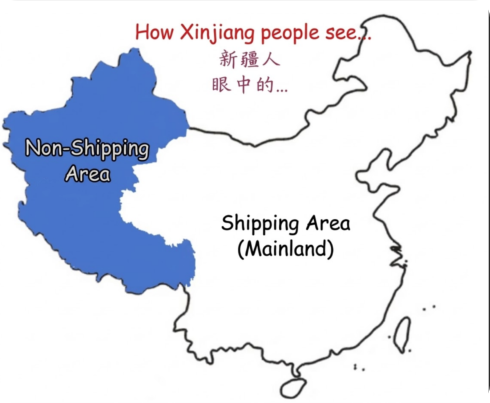
How People in Xinjiang See the Map of China: A Love–Hate Story About Free Shipping and Lag

In the eyes of people from Xinjiang, the map of China only has two regions:

the place that doesn’t get free shipping, and the places that do.

Every time an online store pops up with the words
“Shipping not included for Xinjiang”,
Xinjiang users quietly open their favorites folder and move that long-desired item into a category called
“Maybe in my next life.”

Free-shipping discrimination isn’t the only struggle —
internet speed is the other eternal pain.

When playing online games, teammates on voice chat will start yelling:
“Bro from Xinjiang, you’re lagging again!”
“Are you sending signals by camel or what?”

By the time players in eastern China have already started the next match,
the Xinjiang player is still stuck on the loading screen,
fighting for his life against 460ms ping.

But none of this stops Xinjiang people from turning the stereotype into jokes.

You complain that we live too far away —
we complain that you’ve never seen the sun at 4 AM.

You say our internet is slow —
we say the smell of fresh baked naan and lamb skewers makes every match feel like
an immersive slow-motion experience.

After all, on a land that takes up one-sixth of China’s territory,
life moves a little slower —
slow enough to enjoy hot big-plate chicken, sweet grapes,
and the calm attitude of
“I’m not in a hurry, the world can wait.”

Free shipping might not include us.
Lag might never go away.

But Xinjiang optimism —
and Xinjiang food —
are forever.


Meme Explanations (for non-Chinese readers)

“Xinjiang not eligible for free shipping”
On Chinese e-commerce platforms, most regions of the country often get free shipping,
but Xinjiang is extremely large and far from major logistics hubs,
so it’s frequently excluded from free-shipping deals.
People from Xinjiang joke about this all the time, saying they’re
geographically isolated by delivery fees.


“Slow internet / high ping in Xinjiang”
Xinjiang is far from China’s main internet infrastructure centers,
so some online gamers may experience higher latency (delay between action and response).
Teammates jokingly say they are
“sending signals by camel”
an exaggerated, playful roast, not real hostility.

It reflects a common part of Chinese online culture,
where different regions casually make fun of each other in a lighthearted way.

How People in Tibet See the Map of China: A Proud Roast About Terrain and Altitude


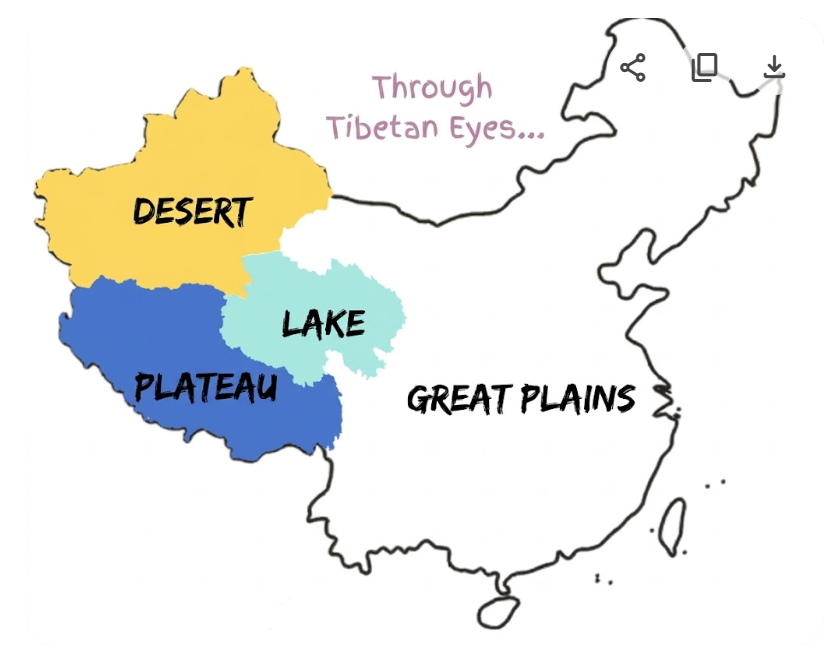
In the eyes of people from Tibet, the map of China can be simplified into three clear zones:
under their feet is the sacred plateau,
to the north is the neighbor’s desert,
to the east is the neighbor’s lake,
and everything else is just
the low-altitude plains.

This way of classifying the world comes with a bit of Tibetan-style pride.
After all, the Qinghai–Tibet Plateau sits at an average altitude of around 4,000 meters,
known as the Roof of the World.
From that perspective, the inland regions — mostly below 1,000 meters —
feel like a giant
low-altitude oxygen zone.

Tibetans traveling to lower regions often joke:
“Why does the air feel so thin here?
Wait… no, there’s too much oxygen.
I think I’m getting oxygen drunk.”

Of course, the roasting goes both ways.
People from the plains complain that Tibet is
“too far away, delivery takes forever,”
and Tibetans reply,
“At least we can see snow mountains and a sky full of stars.”

Some joke that Tibetans ride yaks everywhere,
and Tibetans laugh back,
“You’ve probably never smelled butter tea or tsampa in your life.”

Jokes aside,
this land often called
the place closest to heaven
holds a special place in everyone’s imagination.

The solemn beauty of the Potala Palace,
the crystal-clear water of Namtso Lake,
and the warmth of Tibetan people
make the distance feel worth it.


Because in the eyes of Tibetans,
whether you live in the desert or on the plains,
altitude may be high here —
but the spirit is even higher.

Northeast China See the Map: A Proud Roast About “Home” and the “New Homeland”

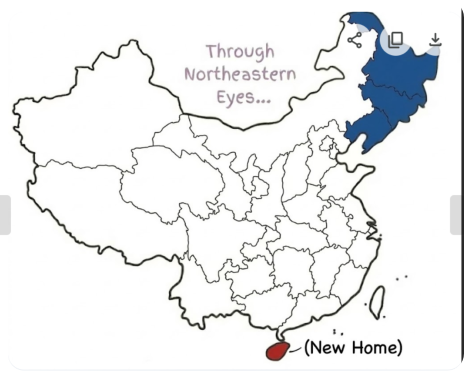
In the eyes of people from Northeast China, the borders on the map are unusually clear:
the blue patch in the upper-right corner is the root,
and the tiny red spot in the far south is the soul.

After all,
“Winters are too cold — time to go spend the season in Hainan”
has long been an unspoken agreement among Northeasterners.
Because of this, Hainan is jokingly called
“the Fourth Province of the Northeast”,
a place everyone quietly agrees is their
new homeland.

This geographic worldview comes with a whole bundle of self-roasting memes.

“The whole country is a Northeastern dialect expansion zone”
In the eyes of Northeasterners,
if someone suddenly says
“aiya ma ya” or “zheng liang ju”
that’s basically a fellow Northeasterner.
Doesn’t matter if you’re in Shenzhen or Sanya —
once that unmistakable accent shows up,
you know the Northeast has spread its linguistic influence again.

“Winter is migration season”
When temperatures in the Northeast drop to −30°C,
retirees start packing their bags and heading straight to Hainan.
Soon the wet markets in Sanya are full of Northeastern aunties bargaining loudly,
the beaches are full of uncles in floral shorts,
and even the coconuts start to feel like they carry
a hint of sweet-and-sour pork in the air.

“Everything can be ‘zheng’ (整)”
In the Northeastern dictionary,
zheng is the ultimate all-purpose verb.
You can zheng food, zheng drinks, zheng a plan,
even zheng it until it makes sense.
Outsiders get confused fast,
but Northeasterners can keep a conversation going forever
with just this one word.

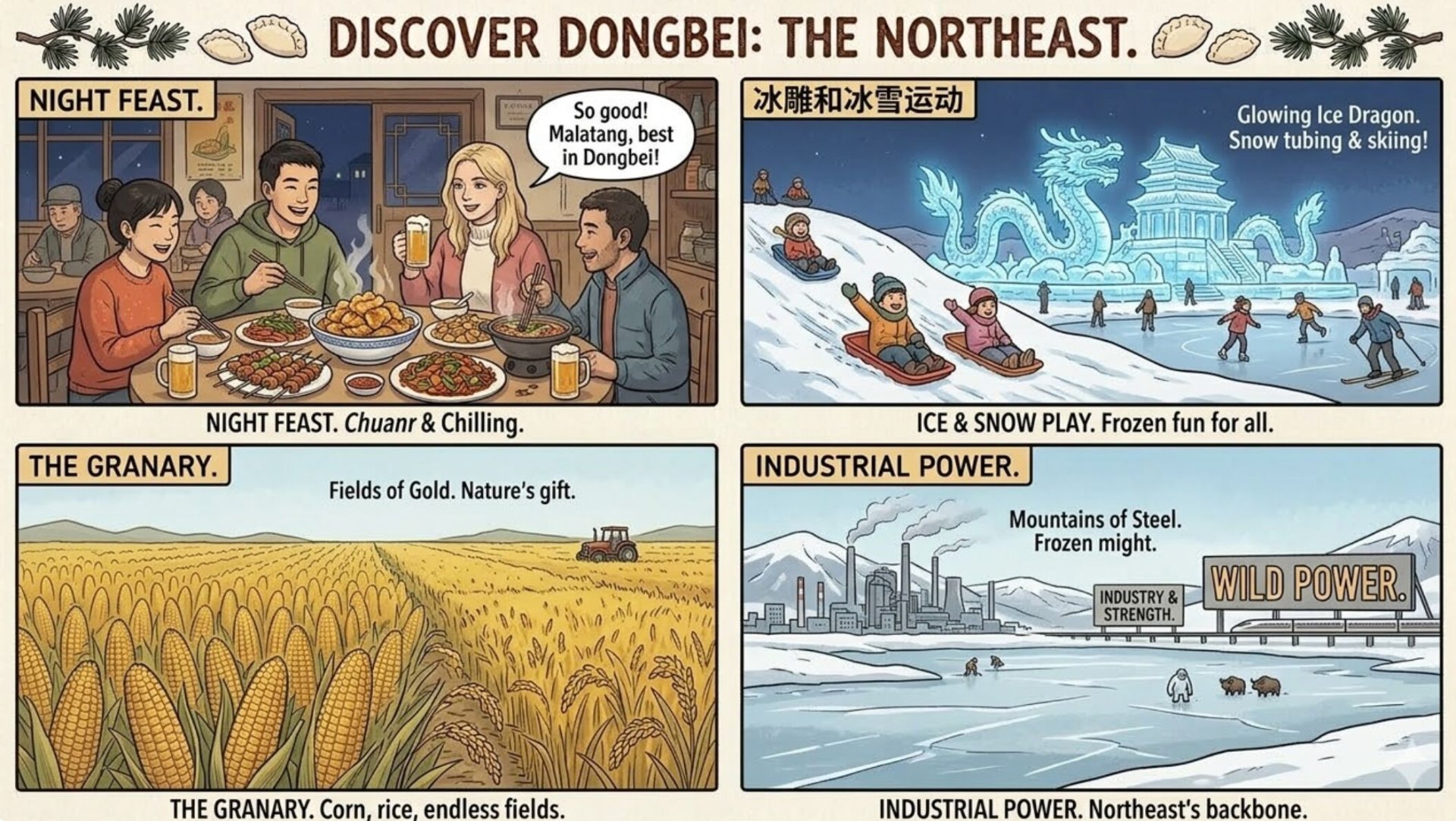
“If it’s barbecue, trust the Northeast”
To Northeasterners,
barbecue anywhere else is just practice mode.
From grilled silkworm pupae to roasted eggs,
from endless skewers to cold beer,
a Northeastern BBQ stand is the real
late-night cafeteria of life.
There’s no problem a barbecue can’t solve —
and if there is,
then you just need two.

Of course, the roasting goes both ways,
but the warmth and loyalty Northeasterners are known for never changed.
They joke that
“Hainan is the real home now,”
while shouting “lao tie, 666!” to friends all over the country.
They use humor to soften reality,
and keep looking for new directions as times change.


Serious background explanation (for non-Chinese readers)

The migration of people from Northeast China to southern regions such as Hainan
has real economic reasons behind the jokes.

Northeast China was once the core of the country’s heavy-industry economy,
but the old industrial base declined and transitioned slowly,
leading to fewer job opportunities.

As a result, many younger people —
as well as middle-aged and retired residents with savings —
moved south in search of
better jobs, warmer weather, and more comfortable retirement conditions.

Over time, this created a seasonal migration pattern,
often called “snowbird migration,”
and the joking nickname
“the Northeast’s fourth province.”

With ongoing economic reforms and revitalization policies,
many people hope the Northeast may one day see
its own comeback story.


Contents
Latest Updates
About This Site

Pop Chinese Dict. is a dynamic online dictionary dedicated to decoding China's trending slang, internet buzzwords, and newly coined phrases. Explore authentic translations, cultural context, and usage examples of the hottest Mandarin expressions in pop culture, social media, and youth discourse.